
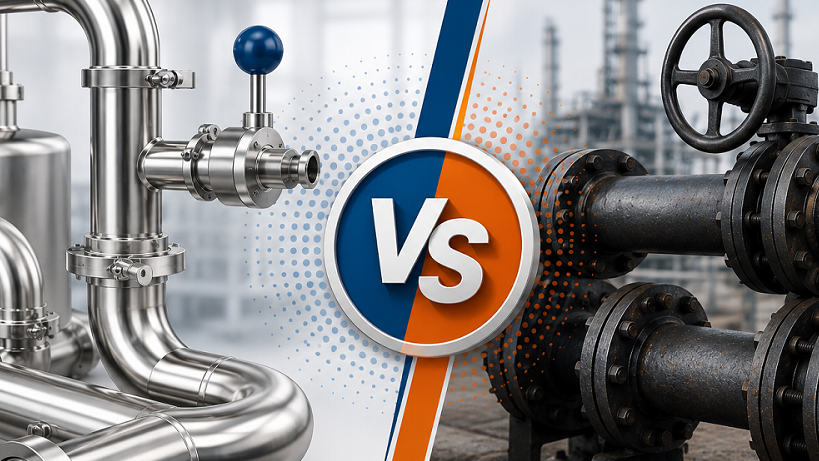
In industries across Canada, piping systems play a critical role in maintaining efficient operations, product quality, and workplace safety. However, not all piping systems are designed for the same purpose. While standard industrial piping is commonly used in manufacturing plants, power facilities, and processing operations, sanitary piping is specifically engineered for environments where hygiene is essential. Industries such as food and beverage processing, dairy production, pharmaceuticals, biotechnology, and cosmetics rely heavily on sanitary piping to prevent contamination and maintain strict quality standards.
As Canadian businesses continue to face increasing regulatory requirements and consumer expectations for product safety, understanding the differences between sanitary and standard industrial piping has become more important than ever. Selecting the wrong piping system can lead to contamination risks, costly downtime, compliance violations, and reduced product quality. Although both systems transport liquids, gases, and other materials, their design, construction, maintenance requirements, and intended applications differ significantly.
What is Sanitary Piping?
Sanitary piping is a specialized piping system designed to transport products in environments where cleanliness and contamination prevention are top priorities. It is commonly found in food processing facilities, breweries, dairy plants, pharmaceutical manufacturing facilities, and biotechnology laboratories throughout Canada.
Unlike conventional piping, sanitary piping is manufactured with smooth interior surfaces that minimize the buildup of bacteria, residue, and contaminants. Most sanitary systems are constructed from high-grade stainless steel, typically 304 or 316 stainless steel, because these materials offer excellent corrosion resistance and can withstand frequent cleaning and sterilization processes.
One of the defining features of sanitary piping is the use of hygienic connections, such as tri-clamp fittings, which allow for easy disassembly, cleaning, and inspection. Welds are carefully polished to create a seamless interior surface, eliminating crevices where microorganisms could grow. Many systems are also designed to support Clean-in-Place (CIP) and Sterilize-in-Place (SIP) procedures, allowing facilities to clean and sanitize equipment without dismantling the system.
What is Standard Industrial Piping?
Standard industrial piping is designed primarily for durability, efficiency, and the safe transportation of materials rather than strict hygiene requirements. These systems are commonly used in manufacturing plants, oil and gas facilities, power generation stations, chemical processing plants, mining operations, and water treatment facilities across Canada.
Industrial piping can be constructed from various materials, including carbon steel, stainless steel, copper, PVC, fiberglass, and specialized alloys, depending on the operating environment and the substances being transported. The primary focus is often on pressure resistance, temperature tolerance, corrosion protection, and overall system reliability.
Unlike sanitary piping, industrial piping systems typically use threaded, flanged, welded, or mechanical connections that prioritize strength and operational performance. Surface finishes are generally not polished to sanitary standards because contamination prevention is not the primary objective. As a result, industrial piping is often more cost-effective for applications where hygiene regulations are not a concern.
Key Differences Between Sanitary and Standard Industrial Piping
The most significant difference between sanitary and industrial piping lies in their intended purpose. Sanitary piping is engineered to maintain product purity and prevent contamination, while industrial piping is designed to transport materials safely and efficiently under demanding operating conditions.
Surface finish is another major distinction. Sanitary piping features highly polished interior surfaces that reduce bacterial growth and facilitate cleaning. Standard industrial piping may have rougher internal surfaces that are acceptable for industrial processes but unsuitable for food, beverage, or pharmaceutical applications.
Connection methods also differ considerably. Sanitary systems utilize hygienic fittings that can be easily inspected and cleaned, whereas industrial systems commonly use flanges, threaded fittings, or welded joints optimized for pressure and structural integrity.
Maintenance practices further highlight the differences. Sanitary systems require routine cleaning, validation, and inspection to comply with food safety and pharmaceutical regulations. Industrial systems focus more on operational reliability, leak prevention, and equipment longevity. While both systems require maintenance, sanitary piping often involves more rigorous cleaning protocols and documentation requirements.
Cost is another factor. Because sanitary piping requires specialized materials, precision fabrication, polished finishes, and strict installation standards, it is generally more expensive than standard industrial piping.
Canadian Regulations and Industry Requirements
Canada maintains strict standards for industries that handle consumable and pharmaceutical products. Food and beverage manufacturers must comply with regulations enforced by the Canadian Food Inspection Agency, while pharmaceutical producers must meet stringent quality and manufacturing requirements.
Sanitary piping plays a critical role in helping facilities comply with these regulations. Properly designed hygienic systems reduce contamination risks, support effective cleaning procedures, and help businesses maintain consistent product quality. In sectors such as dairy processing, craft brewing, pharmaceutical manufacturing, and biotechnology, sanitary piping is often a fundamental requirement rather than an optional upgrade.
Industrial piping, on the other hand, remains essential for supporting utilities, steam systems, compressed air networks, chemical transport systems, and manufacturing operations where hygienic design is not required. Many Canadian facilities use both sanitary and industrial piping systems within the same plant, depending on the specific application.
Choosing the Right Piping System for Your Facility
At companies like Axiom Trades, selecting between sanitary piping and standard industrial piping depends entirely on the operational requirements of the facility and the demands of the application. If the system will come into direct contact with food products, beverages, pharmaceuticals, cosmetics, or other sensitive materials, sanitary piping is the clear choice. Its hygienic design helps protect product integrity, supports regulatory compliance, and minimizes contamination risks.
For applications involving utilities, industrial processing, chemical transport, or general manufacturing operations, standard industrial piping often provides the durability and cost-effectiveness needed for long-term performance. The key is understanding the demands of each process and ensuring the piping system aligns with safety, regulatory, and operational requirements.
As Canadian industries continue to modernize and prioritize efficiency, investing in the right piping infrastructure remains one of the most important decisions a facility can make. Whether the goal is maintaining product purity or maximizing industrial performance, choosing the correct piping system lays the foundation for safe, reliable, and efficient operations.