
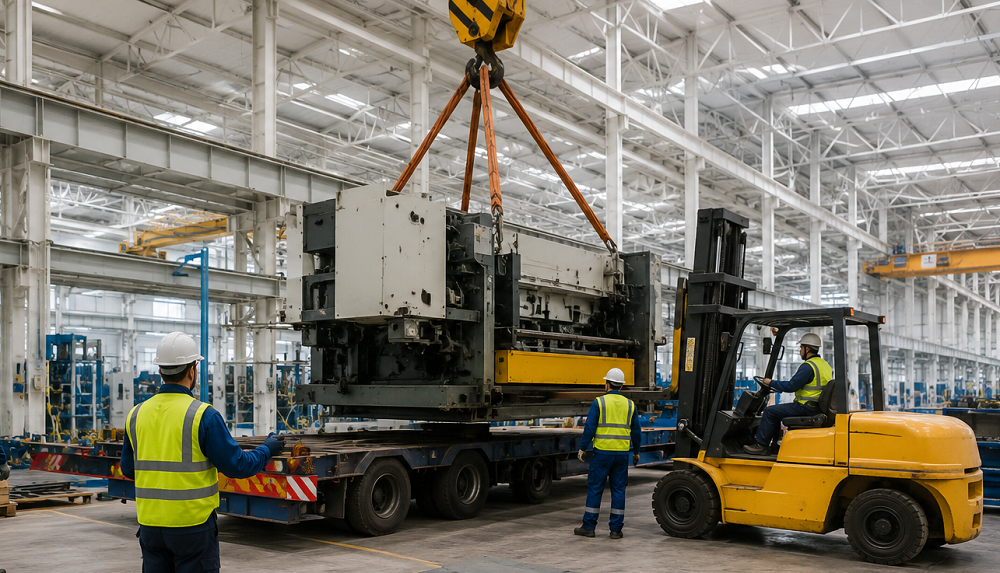
Relocating a manufacturing facility is one of the most challenging projects an industrial business can undertake. Whether you are expanding production, consolidating multiple facilities, replacing an aging plant, or moving closer to customers, the success of the project depends on planning, not transportation alone. Across North America, manufacturers are investing in new facilities to improve supply chain resilience, adopt automation, increase production capacity, and reduce operating costs. However, every hour of unplanned downtime can impact production schedules, customer commitments, and revenue. That’s why successful plant relocations begin with months of engineering reviews, risk assessments, equipment inventories, and detailed project scheduling. Rather than treating relocation as a moving project, leading manufacturers approach it as a business continuity initiative that protects productivity while preparing the operation for long-term growth.
Build a Detailed Relocation Strategy Before Disconnecting Equipment
A comprehensive relocation plan should identify every asset, utility connection, production line, and dependency before dismantling begins. Production equipment, electrical systems, process piping, compressed air, automation controls, structural steel, and material handling systems all need to be documented and evaluated. At the same time, the destination facility must be assessed to confirm that it can support equipment loads, power requirements, ventilation, drainage, network infrastructure, and future production expansion. In North America, manufacturers must also comply with applicable workplace safety regulations, local building codes, environmental requirements, and industry-specific standards before restarting operations. Companies that involve engineering, operations, maintenance, and project management teams early in the planning phase are better positioned to identify potential bottlenecks, develop realistic shutdown schedules, and reduce costly project delays.
Safety Must Remain the Top Priority Throughout the Relocation
Industrial relocation introduces significant safety risks because heavy equipment, energized systems, and multiple contractors often work simultaneously. Before machinery is disconnected, hazardous energy must be isolated using proper Lockout/Tagout (LOTO) procedures. OSHA‘s Control of Hazardous Energy standard (29 CFR 1910.147) requires employers to isolate electrical, hydraulic, pneumatic, mechanical, thermal, and other energy sources before servicing or maintenance begins, helping prevent unexpected equipment startup that could result in serious injuries. OSHA also emphasizes employee training, documented energy-control procedures, and verification that equipment has been fully de-energized before work starts. For complex plant relocations involving multiple contractors or extended shutdowns, coordinated group Lockout/Tagout procedures become especially important to ensure every authorized worker remains protected throughout the project.
Prepare the New Facility for Efficient Installation and Commissioning
One of the most common reasons relocation projects exceed budget is that the receiving facility is not completely ready before equipment arrives. Structural modifications, utility installations, electrical distribution, process piping, equipment foundations, network systems, and ventilation should be completed well in advance. Rather than duplicating the previous plant layout, manufacturers should evaluate opportunities to improve workflow, eliminate unnecessary material handling, increase automation, and simplify future maintenance. Before production resumes, every machine should undergo proper alignment, calibration, electrical verification, mechanical inspection, and operational commissioning. Many manufacturers also perform Factory Acceptance Testing (FAT) before equipment leaves the supplier and Site Acceptance Testing (SAT) after installation to confirm machinery performs according to design specifications. These validation steps help identify issues before full-scale production begins, reducing the risk of unexpected downtime after startup.
Choose an Integrated Industrial Partner to Reduce Downtime
Plant relocation requires expertise that extends far beyond transportation. Successful projects depend on experienced professionals who can manage custom fabrication, rigging and millwright services, mechanical piping, electrical integration, commissioning, and project management under a single coordinated plan. This integrated approach minimizes communication gaps, improves scheduling, and reduces the likelihood of costly errors during installation. After commissioning, manufacturers should continue monitoring equipment performance, update preventive maintenance schedules, train employees on new workflows, and verify that production targets are being achieved. When executed correctly, a plant relocation becomes more than a facility move, it becomes an opportunity to improve operational efficiency, strengthen workplace safety, modernize manufacturing processes, and build a more resilient operation for the future. For North American manufacturers facing increasing competition and evolving supply chain demands, careful planning and experienced execution remain the foundation of a successful plant relocation.